

The first steps with the blockchain
The first steps with the blockchain
This blockchain is not stored in a single location by a single entity, but is replicated in multiple locations by multiple participants or nodes, making it a secure way to store information. This means that in order to alter this information, permission from the majority of these participants or nodes would be required, making it very difficult to do so fraudulently.
How does a blockchain work
Transactions carried out within a blockchain are recorded in what could be considered a digital “ledger”. Each block in the chain records a set of transactions carried out during a period of time (for example, in the case of Bitcoin, some 10 minutes). Once this set of transactions has been verified, the block containing them is incorporated in the blockchain.
The blocks are linked together using cryptography and each one contains, in addition to the aforementioned list of transactions, a “hash”, which is a fixed-length alphanumeric code, generated by a cryptographic algorithm that uniquely represents a set of data (a document, an image, etc.). Each block includes the hash of the previous block, which links the blocks (and therefore the transactions contained in those blocks).
Any change in a previous block invalidates the hash of the next block. In addition to the above, in a blockchain there is no central entity responsible for storing this transaction record, but rather there are multiple participants or nodes in the network that have a copy of this record, which is why it is considered a “distributed network”.
While this technology is known for its use in the field of cryptoassets, it is also used in a wide variety of applications, such as asset ownership verification, supply chain management, and online voting.
Immutability, resilience and traceability
An example of how a blockchain can be used to provide immutability, resilience and traceability can be seen in the food sector.Imagine a vegetable supply chain where each batch is recorded on a blockchain from the moment it is planted until it is purchased by the end consumer. Every time these batches change hands during production and manufacturing, the record would be updated automatically and immutably, allowing for traceability.
Immutability refers to a blockchain’s ability to avoid unauthorised changes in data. As mentioned above, the information recorded on the blockchain is not stored in a central registry, but rather multiple copies of this information are stored on different nodes in the network (hence the characterisation as a “distributed network”), which makes it difficult to modify the information fraudulently.
Resilience refers to the a blockchain’s ability to continue functioning in the face of failures or problems. Since it is a distributed network made up of numerous nodes that maintain a copy of the registry, if any node in the network fails, the data would still be available on other nodes.
Finally, traceability means that information is added in blocks, without it being possible to modify the information added to previous blocks. In the example of vegetables, this allows consumers to trace the blockchain so that they can know exactly the path their product has taken to reach them.
In this way, a blockchain is an immutable, resilient and traceable record, that is, a database that only allows records to be added by consensus, and in which all participating nodes contribute to creating a system that is resistant to failures or fraudulent modifications.
Find out the differences between the different blockchains 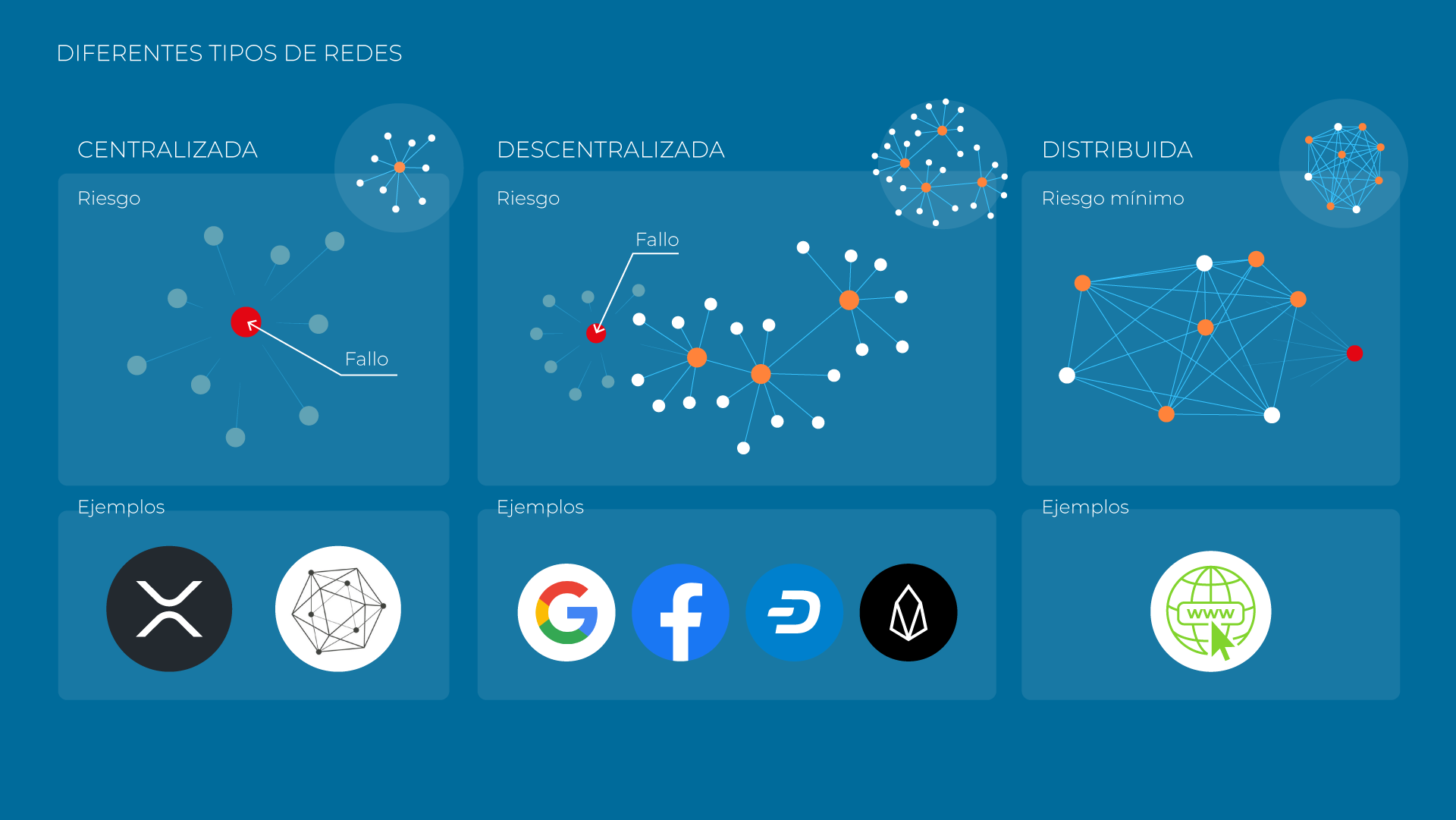
Permissionless public blockchain
This was the first type of blockchain to exist, and refers to those whose information is accessible without permission via the Internet. These types of blockchains keep their data and history open to the public, as well as their software and development, so that anyone can participate in them as a node and/or review, audit, develop, or improve said data. Examples of this type of permissionless public blockchains are Bitcoin, Ethereum, Cardano, Solana or Polkadot.
Private blockchain
With the evolution of distributed ledger technology and its expansion, many companies have developed private solutions, which generally have the same elements as a public blockchain, but only authorized persons can access the network and permission is required to be a node and validate transactions. In general, any private blockchain is, by definition, a permissioned network.There is a central entity that manages the network and grants access to users, therefore the information included in the blocks is not public.
Examples of private blockchain technology are Hyperledger, Corda or Quorum.
Hybrid blockchain
These would be permissioned public networks, that is, a fusion between public and private networks. In these networks, participation is permissioned, meaning that access to their resources is controlled by one or more entities. However, registration is publicly accessible, and anyone can explore everything that happens on the network, block by block.
This type of blockchains is very useful to governments, business organizations and groups of companies that want to store and share data securely, for example, in the healthcare sector, where they have been used to store data from their drug production lines. This is the case of the pharmaceutical company Pfizer, which in 2017 developed a blockchain-based system to ensure the traceability of its vaccines and healthcare products. Other examples of permissioned public networks are Hedera or Alastria.
The objective of applying this blockchain model is to maintain a high level of transparency and trust.